

July 30, 2026
What Solar’s Recent Consolidation Wave Means for Hiring
By: Jon Semingson
TL;DR
- Three deals broke within the same week:
- Unirac acquired Terrasmart’s racking business for $5 million
- NextEra and Dominion filed for merger approval in a $67 billion deal, combining roughly 110 GW of capacity
- Array Technologies acquired Affordable Wire Management for $203 million
- Many new deals typically follow some version of the three phase pattern:
- Layoffs
- Recalibration
- Then finally real hiring
- Speaking of hiring, any business looking to add headcount needs to start soon
- A search realistically takes 8 to 15 weeks from start to full ramp
- Waiting even a few more weeks risks getting waylaid by the holidays instead of getting ahead of them
- Whoever moves first, hiring manager or candidate, gets ahead of the crowd that shows up once these same deals finalize and everyone else starts scrambling at once
On July 15 and 16, 2026, three significant deals rippled through solar and renewables within 48 hours of each other. Together, they mark a shift in how this industry is consolidating, and they tell hiring managers exactly where pressure is about to build.
The M&A Wave
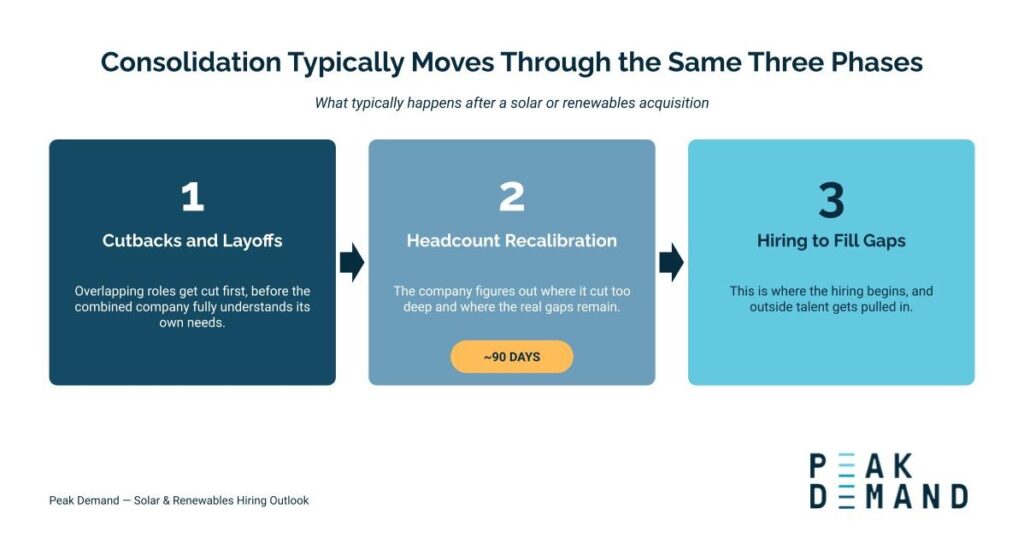
Usually, part of an M&A involves cutting costs in the new org by reducing headcount in redundant areas. This plays out more in deals built around overlapping product lines than in growth driven ones.
Operations, Marketing, HR, and Leadership roles are usually consolidated. After some time (normally 60 to 90 days later), the new organization realizes what gaps exist and where they need to add new roles to the team to help reach the new growth the acquisition was made to target. The breakdown below shows roughly how that timeline tends to play out.
Unirac and Terrasmart
Unirac acquired Terrasmart’s racking business from Gibraltar Industries for $5 million, extending its product line beyond residential and commercial flat roof mounting into the commercial, industrial, and distributed generation segments. Unirac CEO Peter Lorenz called it “a natural extension of our DG platform.”
Hiring here is coming, but expect it to land closer to that 90 day recalibration window, not immediately.
NextEra Energy and Dominion Energy
This deal does not fit the layoff driven pattern above. NextEra and Dominion filed for merger approval in mid-July, and the logic behind it is growth, not overlap. The all-stock deal is valued at roughly $67 billion, combining into about 110 GW of generation capacity serving close to 10 million utility customers across Florida, Virginia, North Carolina, and South Carolina.
Dominion’s territory, especially Virginia, is facing enormous data center load growth, and analysts have pointed to pressure already building on the region’s grid. NextEra is combining specifically to capture that demand.
Once the deal closes, expect years of integration, compliance, and grid buildout hiring tied directly to that growth curve.
Array Technologies and Affordable Wire Management
Array is paying $203 million to acquire the eBOS provider, AWM. The deal is expected to close in the third quarter of 2026. This follows similar deals with Gamechange acquiring the Terrasmart eBOS division and Nextpower buying Bentek.
The larger OEMs in this space are competing to grab a larger share of their customers’ spend and bring a larger suite of solutions to the market. Expect this type of consolidation to continue. What this means for hiring will become clearer once the deal officially closes.
What This Means for Hiring
Usually, part of an M&A involves cutting costs in the new org by reducing headcount in redundant areas. Operations, Marketing, HR, and Leadership roles are usually consolidated. After the dust has settled a bit (normally 60-90 days later) the new organization realizes what gaps exist and where they need to add new roles to the team to help reach the new growth the acquisition was made to target.
In the meantime, the people who were caught in the layoffs and others that feel vulnerable are likely actively looking. Sometimes, an acquiring company will put retention bonuses in place to keep key people through the transition.
Avoiding a Holiday Hiring Stall
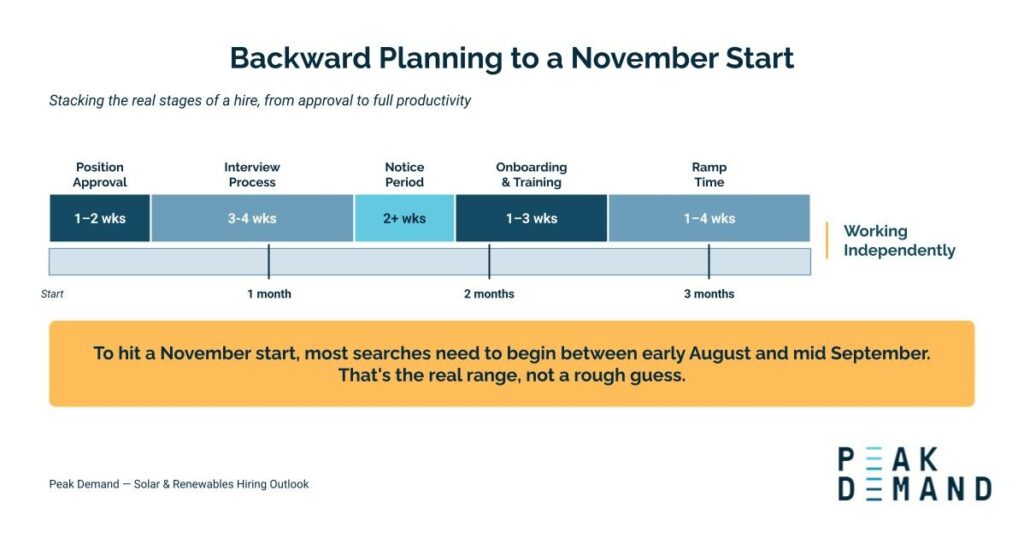
Grabbing someone who is already motivated to leave moves fast, an informal conversation can turn into an offer within days. Running an actual search for an open role is a different process entirely, one that follows a far more predictable, slower timeline. Here is what that looks like stacked together, best case:
- Position approval: 1 to 2 weeks
- Interview process: 3-4 weeks, conservatively
- Notice period: 2 weeks standard, sometimes longer
- Onboarding and training: 1 to 3 weeks depending on the role
- Ramp time: 1 to 4 weeks to contribute independently
The full process runs 8 to 15 weeks from search start to full productivity, best case, assuming nothing runs long, and the company is highly organized. A slow approval or a drawn out notice period can extend the whole process even further.
The holidays are the least productive stretch of the year. Attention splits across PTO, year end planning, and slower decision making across the board. A hire who is fully ramped before that stretch begins ends up contributing exactly when the business is otherwise coasting, instead of still learning the ropes once everyone else has already checked out.
Moving now means landing a hire during the one window when a head start actually counts, right before the season slows everyone else down.
- Sales hires who are closing deals independently before the holidays are already producing revenue during a stretch when most of the market slows down. Every stage in the timeline above eats into that runway, so hitting that window means starting the search now.
- Project-based hires run the same math. Momentum built before the holidays means a real head start, since a search that starts in October often means the new hire is still learning the business in November, right as everyone else’s attention scatters.
- Waiting too long doesn’t just push the start date back, it erases the ramp time entirely, and the hire lands exactly when the business slows down instead of ahead of it.
Companies with approved budget have an edge available right now: moving before the newly combined competitors finish their own recalibration and start competing for the same talent.
What Happens Next
For Hiring Managers
With budget already approved, the math above becomes the actual planning tool. Working backward from the target start date matters more than working forward from whenever the req feels ready to open.
If a competitor just went through one of these mergers, expect renewed competition for candidates once their recalibration finishes. Moving before then is where the real advantage sits.
Whether a role justifies acting now versus waiting for next year’s budget is exactly the kind of conversation worth having before the decision gets made by default. We’re glad to talk it through; that’s exactly the kind of search our recruiting team runs every day.
For Candidates
Anyone wondering what integration means for their own role is not alone. It’s worth having a real conversation about options before any formal announcement changes the leverage on the table.
For anyone quietly open to a move but not actively looking, this kind of market movement is exactly when informal conversations start being worth having.
Anyone working in highly technical roles is in a strong position right now, regardless of which side of a deal they’re on. Reach out any time for a confidential conversation with our recruiting team about what’s next, or browse our current openings directly.
Frequently Asked Questions
How long does it actually take to hire someone in solar and renewables right now?
For a full search that starts from scratch, best case, the process runs 8 to 15 weeks to reach full productivity, which includes approval, interviews, notice period, onboarding, and ramp time. That assumes nothing runs long. Any single stage slipping, a slow approval or a drawn out notice period, pushes the whole timeline past that range.
Is now a good time to look for a new role in solar and renewables if my company is going through a merger?
Often yes, especially for technical talent in engineering, construction, project finance, or interconnection. This is also a good window for passive candidates who weren’t previously looking. Market movement like this tends to open real conversations that would not have happened a year ago.
Which roles are most at risk during solar industry consolidation?
Duplicated corporate functions are typically first: senior management, marketing, finance, and HR roles that exist at both companies before a merger closes. These positions overlap by definition once two organizations combine, which makes them the most predictable source of early layoffs.
Sources
- Unirac to Acquire Solar Racking Business of Terrasmart — PR.com
- Unirac acquires Terrasmart solar racking business — PV Tech
- NextEra Energy and Dominion Energy file to combine — Las Vegas Sun
- NextEra-Dominion Energy Merger Seeks Regulatory Approval — TaiyangNews
- What electric customers should know about the Dominion Energy sale — UVA Darden School of Business
- Array Technologies acquires Affordable Wire Management — PV Tech
- ARRAY Technologies to Acquire Affordable Wire Management — Array Technologies press release
Check out these posts
Let's Talk
Partner with Peak Demand for Expertise in the Renewable Energy Industry. Whether you're an employer seeking top talent or a professional searching for your next opportunity, Peak Demand is here to help.